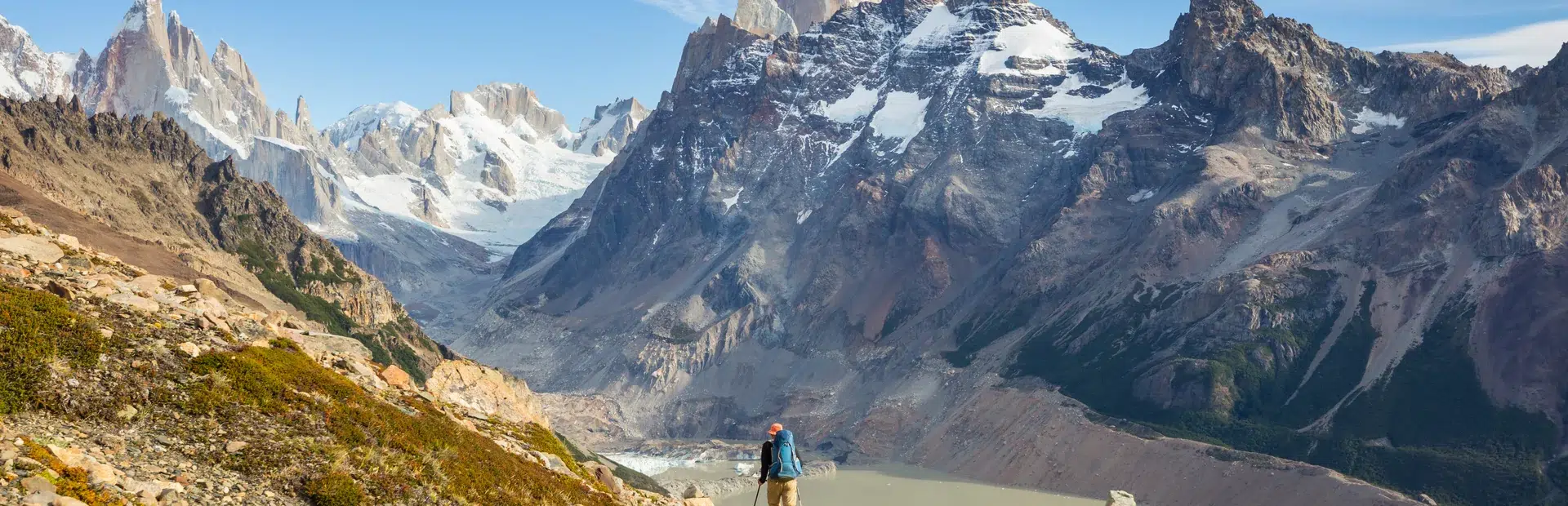
Cerro Torre
the most difficult granite needle in Patagonia
At 3,128 meters, Cerro Torre is lower than the Fitz Roy, But its silhouette is even more dramatic: an almost vertical granite spire, crowned by an ice mushroom formed by the condensation of Pacific winds. It rises above the Southern Patagonian Ice Field, in the northern sector of the Los Glaciares National Park, and forms a cord with the Egger, Standhardt and Bifida needles.
How to view it
Two trails lead to its viewpoints, and neither requires transfers: both start on foot from El Chaltén.
Laguna Torre, the classic trail
The guided trekking to Laguna Torre It passes through a lenga forest and a glacial valley, and reaches a lagoon where icebergs detached from the Glaciar Grande often float, with the Torre mountain range in the background.
They are some 23 km round trip, Similar in distance to Laguna de los Tres but without the steep final climb. Therefore, it is considerably more accessible and a good option for those who want a full day out without extreme exertion.
Loma del Pliegue Tumbado, both massifs at once
If you want to see Cerro Torre and Fitz Roy in the same view, the ascent to Loma del Pliegue Tumbado It offers a 360-degree panoramic view of the two massifs, the glaciers, and the steppe. It is more demanding: 20 km and more than 1,000 meters of elevation gain.
The ice mushroom and the difficulty of climbing it
The formation that crowns the summit is the distinctive feature of the Torre and also part of the reason why it is so difficult to climb.
How it is formed
It is formed by the accumulation of ice carried by moisture-laden winds from the Southern Patagonian Ice Field, and its shape and size change depending on the season. This unstable layer can break off without warning, making it one of the risk factors of the ascent.
A story of controversy
Cerro Torre has one of the most debated stories in mountaineering. In 1959, Cesare Maestri claimed to have reached the summit with Toni Egger, who died on the descent, taking with him the camera containing the supposed evidence. The lack of evidence and the inconsistencies in the account sparked a debate that lasted for decades.
In 1970, Maestri returned with a motorized compressor to install hundreds of pitons in the rock, a decision the climbing community considered contrary to the ethics of mountaineering. The compressor remained hanging on the wall for forty years, and in 2012 two climbers removed a large number of those pitons, reopening the debate.
The first uncontroversially recognized ascent is attributed to the 1974 route by the Italian group known as the Ragni di Lecco.
When to go and what to expect
The excursion season runs from October to mid-April.
An honest warning
Cerro Torre It spends even more time covered than Fitz Roy.It is more exposed to weather fronts arriving from the Pacific. Clear mornings offer the best conditions, and it's advisable to spend several days in the town to increase your chances of seeing it. Therefore, we recommend not leaving this hike until the last day of your trip.
Plan your visit
Check the complete catalog of excursions or our guide to What to do in El Chaltén.